Research
For as long as I can remember, I have always been fascinated by technology and driven by an eagerness to discover new things through curiosity. This passion stems from my father, whose role in shaping my research career has been vital. He introduced me to technology when I was a young child, and together with my mother, consistently encouraged me to pursue a career in science and engineering.
I spent my early days playing with Legos and memorizing the Star Wars saga. When I was old enough, I received my first Lego Mindstorms set, which was truly a game changer. Through it, I learned to program basic instructions, read sensor data, and debug my numerous mistakes. Most importantly, it sparked a fundamental question that continues to drive my research today:
How can we teach machines to see and understand the world the way we do?
I'm currently enrolled in a Bioinformatics B.Sc. at the University of Málaga, where I've been conducting research in Computer Vision for Biomedical Applications since my third year. My work sits at the intersection of generative modeling and medical imaging—I'm drawn to understanding how learned representations and latent spaces can capture the structure of complex biomedical data. Lately, I've been exploring diffusion models, mean flow, and other generative frameworks as tools for tasks where labeled data is scarce and the stakes are high, such as lesion detection in angiography and MRI synthesis for neurological conditions.
Outside of my main research, I enjoy spending time going for hikes, playing tenis, and reading math books.
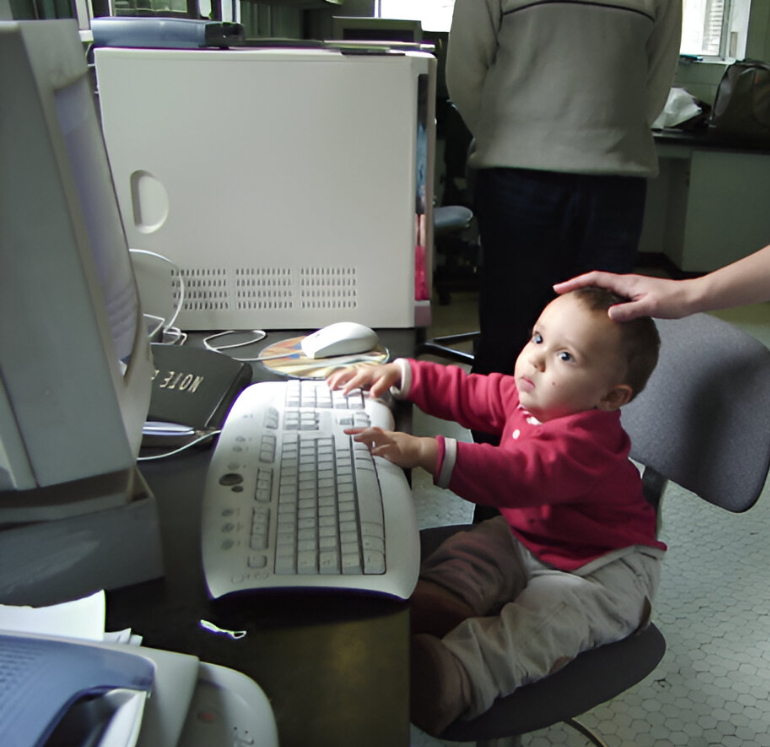
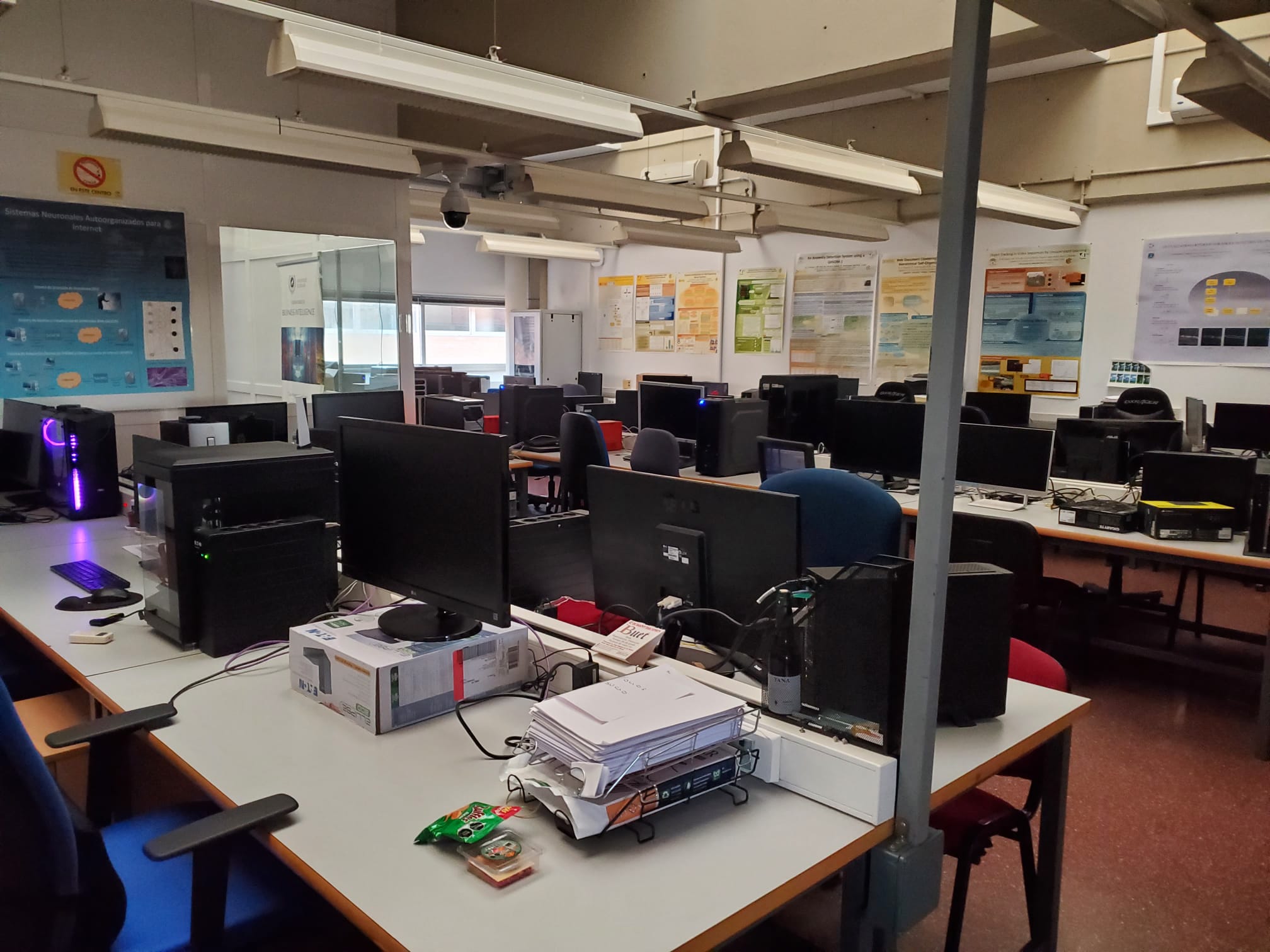
Computational Intelligence and Image Analysis Group
I first encountered Artificial Intelligence during the fifth semester of my Bioinformatics B.Sc, while being enrolled in the course "Intelligent Systems". There, I met Ezequiel López-Rubio, PhD, who recognized my enthusiasm for AI and agreed to mentor me in the field. Under his guidance, I began developing projects that gradually strengthened my deep learning-related knowledge, with the ultimate goal of preparing me for my bachelor's thesis research project.
At the end of my third year, Ezequiel and Esteban-José Palomo Ferrer, PhD offered me a Research Assistant position to work on Deep Learning approaches for detecting and characterizing stenosis lesions in invasive coronary angiography videos. This position, affiliated with the Biomedical Research Institute of Málaga (IBIMA), provided me with invaluable hands-on research experience in medical computer vision, where I continue to work today.
Publications during my stay
Optimizando el preprocesamiento de la imagen por resonancia magnética: estimación ciega de ruido con campos aleatorios gaussianos
III Congreso Nacional de Estudiantes de Radiología y Medicina Física, pp. 5--6, 2025
Personal Comments
This is a conference paper that I presented at the III Congreso Nacional de Estudiantes de Radiología y Medicina Física, held in Málaga in 2025. The paper describes a method for blind noise estimation in MRI images using Gaussian random fields, which can be used to optimize the preprocessing of MRI images for subsequent analysis. The code is not publicly available, but the paper provides a detailed description of the method and the results obtained on a dataset of MRI images, this was a "fun" experiment, where I learned a lot about statistical properties of MRI noise and its physics.
Hyperparameter optimization of YOLO models for invasive coronary angiography lesion detection and assessment
Computers in Biology and Medicine, vol. 196, pp. 110697, 2025
Personal Comments
My first scientific publication. Leaving the statistical analysis aside, the code provides an easy tool that is able to integrate the hyperparameter optimization of any YOLO variant using the Optuna framework. You only have to define your trainer at optimization/engine/trainers. The script optimization/engine/hpo.py will catch your trainer class and optimize it with the configuration you defined (see example at optimization/cfg/files/picasso/yaml), where you must write your trainer class in the model_source entry.
Personal Comments
Preprint, sent to the IEEE ICIP 2026 conference. The code provides a PyPI package that allows you to easily train your own diffusion model with the SLIM-Diff architecture, which is especially designed for data-scarce 2D MRI synthesis tasks. The paper also provides empirical evidence that the manifold hypothesis holds for pixel-space generation of medical images, a claim that 'One-step Latent-free Image Generation with Pixel Mean Flows' (Yiyang Lu et.al) made, with theoretical grounding.